The Importance of Time and Effort in Assessment Literacy
Assessment literacy (AL) refers to the ability of both students and academic staff to understand the purpose, design, and expectations of formative and summative assessments. For students, assessment literacy is understanding why they are being assessed, how assessment is designed, and what success looks like.
Research conducted as part of a QAA Collaborative Enhancement Project, led by Coventry University, showed that only 63% of students are familiar with the term assessment literacy and they explained the term as
- being able to understand assessment processes, including criteria, grading, and expectations;
- actively engaging in autonomous learning, such as self-assessment, reflection, and time management; and
- developing competencies, such as using feedback to improve performance, and adapting to different assessment types.
When students develop their assessment literacy, they’re more likely to succeed. But for many—especially those new to university or from underrepresented backgrounds—unclear guidance can be a major barrier.
Research shows that students often think they understand assessment criteria better than they actually do. This can lead to confusion, extra work, and surface-level learning. First-year students, in particular, may rely on prior habits that don’t match university expectations.
Lack of understanding of assessment guidelines can lead to unmanageable and increased workloads. When students aren’t sure how much time and effort an assessment requires, they might either spend too little time on it or feel overwhelmed trying to keep up. Clear guidance helps students plan better and encourages deeper learning. This suggests the need for educators to better communicate their expectations to students. The amount of time and effort that a particular assessment requires will vary from student to student, but providing students some suggested guidelines about time requirements can help them better manage their academic and non-academic time.
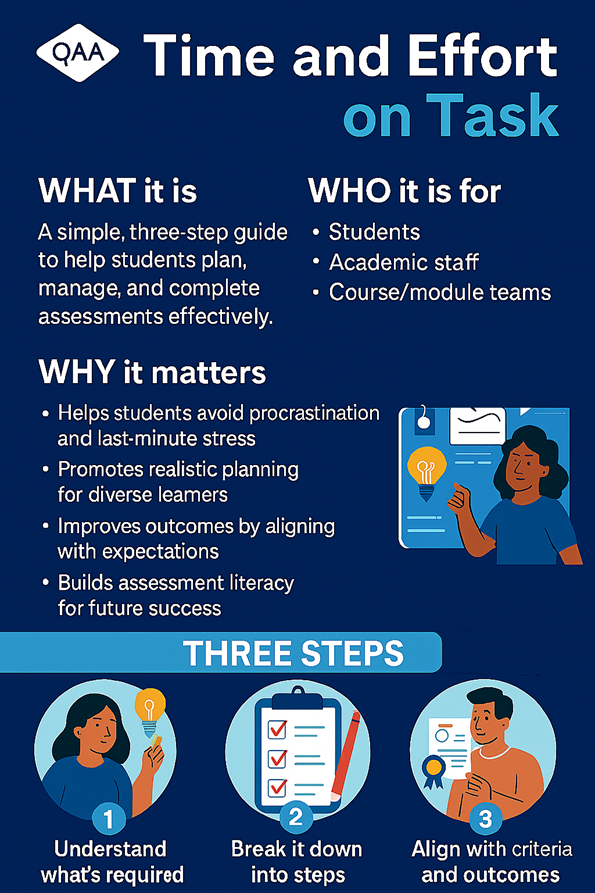
The Time and Effort on Task (TET) toolkit has been designed to support this.
|
|
Applying the Toolkit for StaffWhen introducing assessment tasks to students.
When evaluating the effectiveness of existing assessment tasks.
When designing new assessment tasks:
Applying the Toolkit for StudentsThe tool is designed to help you plan and complete your assessments. You can use it in the classroom, with your peers and your tutor, when your tutor introduces the assessment task.
You can use it when you begin working on a new assessment
Throughout your course
|
It is not expected that this tool will be applicable to all types of assessments at all levels
Explore further guidance for staff and guidance for students, together with further resources on the right of the screen.

The toolkit and all associated resources are licensed under CC-BY-NC-SA 4.0
This toolkit and all associated resources are an output from a Collaborative Enhancement Project supported and funded by QAA membership. The project is led by Coventry University in partnership with Aston University, International University of Applied Sciences, Germany, University of the West of Scotland, and University of West London. Find out more about Collaborative Enhancement Projects on the QAA website.
